
A landmark project in the Niépce House restored by Spéos
To mark the bicentenary of the invention of photography, Spéos and the Niépce House have joined forces with the Magnum Photos agency on a major artistic project: a commission awarded to American photographer Gregory Halpern, invited to create an original series at the historic birthplace of photography, in Saint-Loup-de-Varennes, in Burgundy.
This project extends Spéos’s longstanding commitment to the world’s photographic heritage. Since 1999, it has indeed been the Spéos photography school that has been restoring and showcasing the Nicéphore Niépce House — the very place where, two centuries earlier, Niépce perfected photography.
Now designated a Maison des Illustres, this house stands as an essential site for understanding the origins and history of photography.
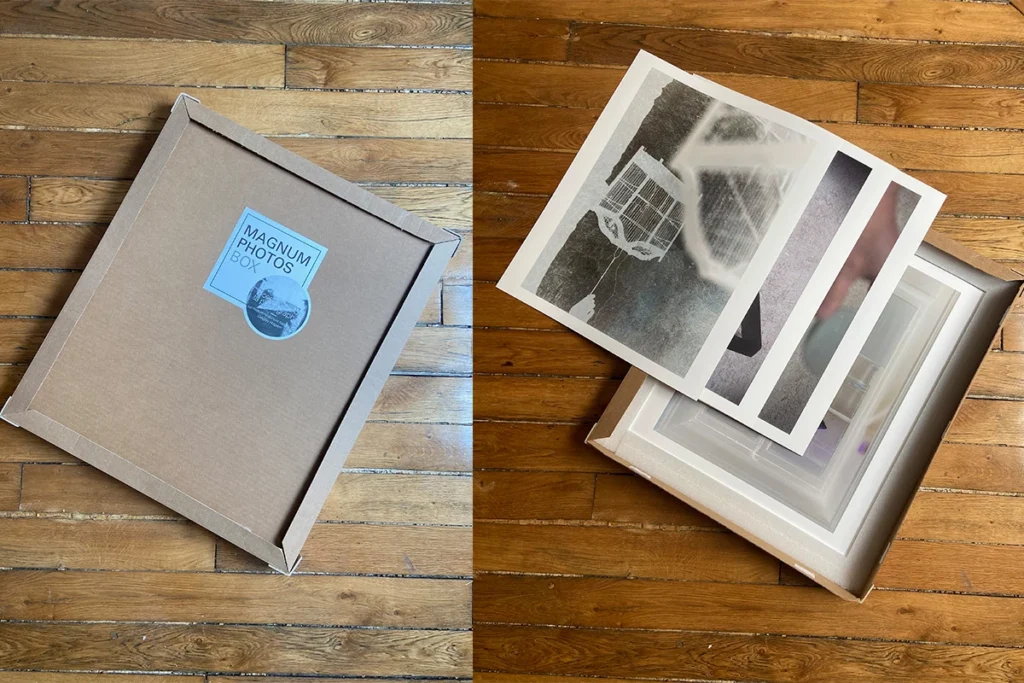
To make this celebration accessible to as wide an audience as possible, the series produced by Gregory Halpern is being released as a “turnkey exhibition box,” ready to be hung by cultural institutions. Distribution and sales of the box are handled by Magnum Photos.
Gregory Halpern, the fourth artist invited to the Niépce House
With this project, Gregory Halpern becomes the fourth artist to work at the Niépce House, following Paolo Roversi, Daido Moriyama and Janine Niépce. The photographer stayed on site for several days, observing the light, the volumes and the traces of time that permeate this historic place.
This residency gave him the opportunity to reflect on Niépce’s founding gesture and on the birth of the photographic gaze: “I wanted to spend time at Niépce’s window, to reflect on the original desire to fix an image and on the birth of an idea that would go on to shape the modern imagination,” he confides.
G. Halpern envisioned the window through which Niépce produced, in 1827, the famous Point de vue du Gras — regarded as the earliest surviving photograph — as a primitive viewfinder, and the house itself as a vast camera. Rather than documenting the site, his images visually explore time, light and the memory of place. Through fragments, details and atmospheres, the series sets the origin of photography in dialogue with contemporary creation.
A strong link with the Rochester Institute of Technology
This collaboration carries particular meaning for Spéos: Gregory Halpern teaches photography at the Rochester Institute of Technology (RIT), an institution with which Spéos has partnered for more than 40 years. The project illustrates the wealth of international bridges the school has built around fine-art photography and the transmission of knowledge.
A graduate of Harvard University and of the California College of the Arts, Gregory Halpern now lives in Rochester, in the State of New York. A Guggenheim Fellow, he is represented by Magnum Photos and ranks among the most acclaimed contemporary photographers of his generation.
The author of eight monographs, he has for several years been developing a body of work attentive to landscapes, atmospheres and collective narrative, offering a poetic reading of reality and probing the way territories nourish our imagination.
His photographs are held in the collections of major international institutions: the Museum of Modern Art (New York), the San Francisco Museum of Modern Art, the Museum of Fine Arts, Houston, and the Fotomuseum Antwerpen. His work is also represented in the collections of the Henri Cartier-Bresson Foundation and the Fondation d’entreprise Hermès.
The Niépce House, fully restored and safeguarded by Spéos since 1999
The Nicéphore Niépce House holds a unique place in visual history. It was in this family home, in Saint-Loup-de-Varennes, that between 1816 and 1832 Niépce conducted his research into fixing images by means of light, eventually inventing photography in 1824. There he developed heliography, a process based on the use of bitumen of Judea applied to a surface (stone, tin, copper, glass, and then a silvered plate) exposed to light.
The house still preserves today the rooms in which these pioneering experiments were conducted. Engaged in its restoration since 1999, the Spéos school has turned it into a major heritage site dedicated to passing on the history of photography. Two centuries after Niépce’s invention, this place remains the symbolic starting point of the photographic medium.
A ready-to-hang exhibition for cultural institutions
To broaden the project’s reach, Gregory Halpern’s series is offered as a fully prepared photographic exhibition box. Media libraries, town halls, cultural centers, art schools, universities, museums, heritage venues and French Institutes abroad can therefore host a contemporary exhibition built around the bicentenary of photography, with no production constraints.
The box brings together everything required for installation: the photographic prints from the series produced at the Niépce House, the introductory texts, the captions and information about the works, and the installation guidelines. It is a solution designed to be easy to purchase, quick to ship and simple to install across a wide variety of cultural venues.
Practical information
- Exhibition: Maison Niépce × Gregory Halpern
- Format: ready-to-hang photographic exhibition box
- Prints: 19 photographs, 50 cm wide, accompanied by 3 texts
- Installation footprint: 50 cm × 22 panels, i.e. 11 linear meters (plus the spaces between panels)
- Price: €3,500
- Distribution: Magnum Photos
- Acquisition contact: Andrea Holzherr — andrea.holzherr@magnumphotos.com


Spéos, an active partner of the bicentenary
By linking the heritage of the Niépce House with the contemporary creation championed by Gregory Halpern and Magnum Photos, Spéos reaffirms its mission: to keep the history of photography alive while supporting the visual writings of today. Every image made in 2026 traces, in one way or another, its roots back to Nicéphore Niépce’s visionary invention — and it is this dialogue between origin and creation that this project sets out to celebrate.